ART
IMPRESSIONISM
The impressionism works are so well known and accepted on our days. During their time in the 1860's these artists were too revolutionary to be accepted easily. In fact many good paintings by these artists were rejected by the official French salon. Then their works were exhibited in Exhibition so-called "Salon des Refuses" - Exhibition of works reflected. However a number of these artists who ere represented in the "Salon des Refuses" formed their group which later they became known as the impressionists.
This group was formed in December 1873 by Monet, Renoir, Picasso, Sisley, Cezane, Berthe Morisot, Edgar Degas and several other artists. The name Impressionist came after the critical article by the news paper 'Le Chaeivari' on the painting by Claude Monet Impression Sunset (impression, Sole ilevant) which stated word play with the title. The article titled 'The Exhibition of the Impressionists' by Leroy. Leroy described the work of Monet was at a most a sketch, and could not be as a finished work.
The Impressionists artists were the first to take their easels out of doors and painted immediately what they saw on site. They wanted to paint only what they saw, what appeared to the eye in a particular light at a particular time of the day. They needed to capture the fleeting moment. So this moment developed a style, techniques and approche to using colour in their paintings.
The Impressionists disconnected that the shadow of an object is broken up with dashes of its complementary colour. The bulk of the impressionists works are mainly Landscapes , seascapes, and Townscapes painted in oil. These artists work fast on their canvas to depict the atmosphere of a particular time of day and the effects of different weathers conditions. The energy of their brush works are very spontaneous these makes the paintings loom fresh as if its painted just a few minutes ago.
However the impressionists marked their sign in the history and became the most popular movement in the history of art.

Impression: The Sunrise
(Impression: soleil levant)
1873
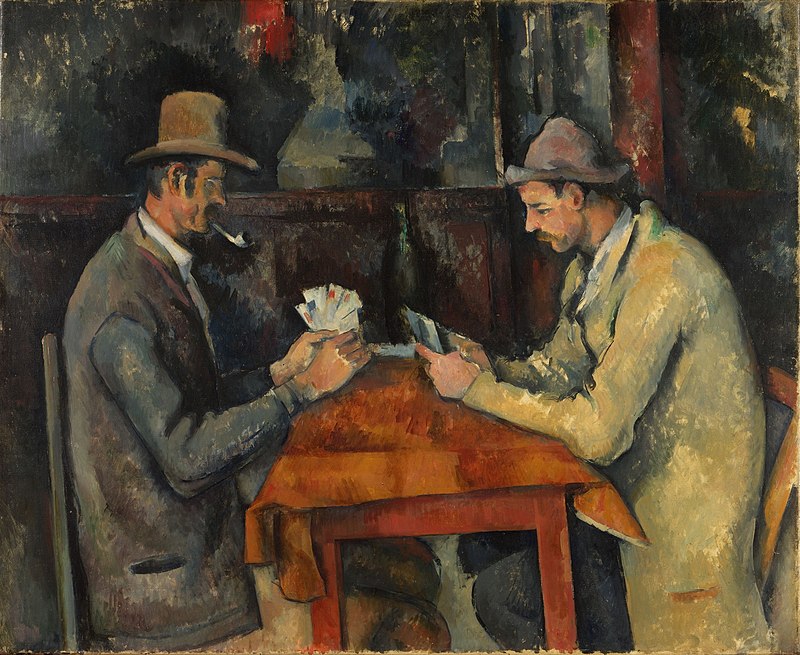
Les joueurs de cartes (The Card Players), 1892–95, oil on canvas, 60 x 73 cm, Courtauld Institute of Art, London by Paul Cezanne.
 Lane Near a Small Town (c. 1864), one of the earliest extant paintings by Sisley.
 Pablo Picasso, Les Demoiselles d'Avignon, 1907, oil on canvas, 8' x 7' 8" (243.9 x 233.7 cm) (Museum of Modern Art, New York)
 Les fiancés, dit le ménage Sisley - 1868 by Renior.
 Berthe Morisot, Grain field, c.1875
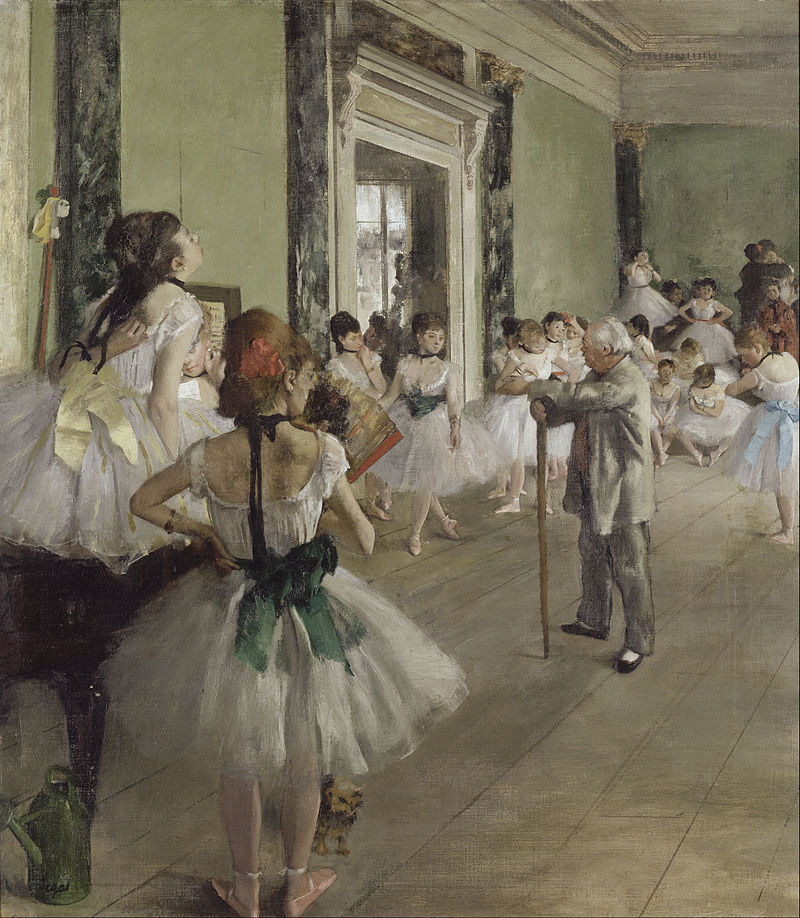 The Dance Class (La Classe De Dance) 1873–1876, oil on canvas, by Edgar Degas.
References:
https://en.wikipedia.org/wiki/Impressionism
Crash Course In Art (1994 Eva Howarth)
Photos: wikipedia
Lane Near a Small Town (c. 1864), one of the earliest extant paintings by Sisley. Pablo Picasso, Les Demoiselles d'Avignon, 1907, oil on canvas, 8' x 7' 8" (243.9 x 233.7 cm) (Museum of Modern Art, New York) Les fiancés, dit le ménage Sisley - 1868 by Renior. Berthe Morisot, Grain field, c.1875 The Dance Class (La Classe De Dance) 1873–1876, oil on canvas, by Edgar Degas.References:
https://en.wikipedia.org/wiki/Impressionism
Crash Course In Art (1994 Eva Howarth)
Photos: wikipedia
Cubism
Cubism was created by artists Pablo Picasso a Spanish painter, sculptor, printmaker, ceramist,stage designer, poet and playwright 1881-1973 and George Braque a French painter, collagist, draughtsman, printmaker and sculptor 1882-1973. This Movement was influenced by the late works of Paul Cezanne. Cezanne struggled in his studies to understand the different angles in a still life, landscape or portraits. Cezanne recombined this observation and depicted as a whole picture. The Cubists Movement described that Paul Cezanne was their mentor.
The term of Cubism was named by the French art critic Louise Vauxcelles after he saw the landscape of Braque l’Estaque in 1908. Vauxcelles called the geometric forms ‘abstracted cubes’. Other influences on early Cubism are from primitive art were Picasso show this evidence, in his famous painting Les Demoislles d’ Avignon painted in 1907. Picasso and Braque eliminate the traditional way of painting, they worked and developed their style by ignoring the rules of perspective and enfaced to show objects from more than one angle. They wanted to depict an object from all different perspectives. If they decided to paint a musical instrument they tried to show all the different facets of the instruments at once by observing and using their memory. The traditional painters painted what they saw; this method is known as perceptual, while the Cubist movement wanted to depict what they knew to be there which is known as conceptual art. The Cubist explained how their new visual language justified the truth, example: ‘if you close your eyes and try to remember what a particular object look like you may well find that you recall it as if seen simultaneously from different angles’. However the Cubist painters dismantled the object in their minds into a number of geometric planes. Each plane is a different facet of that object. Then the artists composed these planes as whole picture. While Picasso and Braque are the co-founders of this movement, this was adopted and further developed by many painters such as Fernard Leger, Robert and Sonia Delaunay, Juan Gris, Roger de la Fresnaye, Marcel Duchamp, Albert Gleizes, Jean Metzinger and Diego Rivera.
Although the Cubist painters reject all the traditional way of paint, they surely are the most important movement in the art history of the 20th century that broke the old boundaries and opened new horizon for modern art.

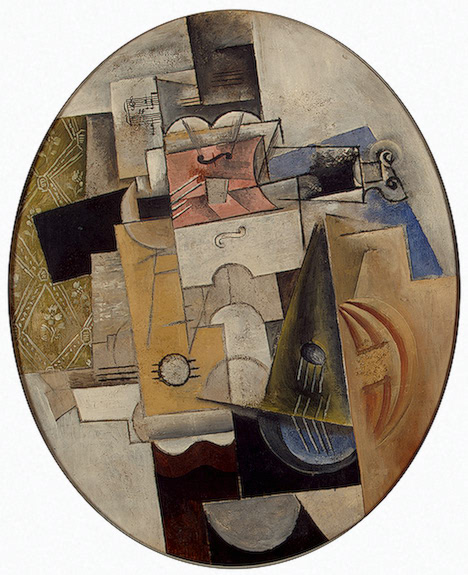 Picasso 'Instruments of Music'
,_oil_on_canvas,_73_x_60_cm,_private_collection.jpg) Braque l’Estaque in 1908.
Braque l’Estaque in 1908. Discs, 1918 by Fernand Leger.
 Diego Rivera, Maternidad, Angelina y el niño Diego (Motherhood, Angelina and the Child Diego), circa August 1916, oil on canvas, 134.5 x 88.5 cm, Museo de Arte Carrillo Gil.
 Jean Metzinger, 1912, Danseuse au café (Dancer in a café), oil on canvas, 146.1 x 114.3 cm, Albright-Knox Art Gallery, Buffalo, New York. Published inAu Salon d'Automne "Les Indépendants" 1912, Exhibited at the 1912 Salon d'Automne
 Albert Gleizes, 1911, Portrait de Jacques Nayral, oil on canvas, 161.9 x 114 cm, Tate Modern, London. This painting was reproduced in Fantasio: published 15 October 1911, for the occasion of the Salon d'Automne where it was exhibited the same year.
References:
Crash Course In Art (1994 Eva Howarth)
https://en.wikipedia.org/wiki/Cubism
http://www.britannica.com/art/Cubism
The story of art (1989 Gombrich)
Photos: wikipedia

No comments:
Post a Comment